
In today’s competitive housing market, visuals play a powerful role in how buyers perceive a property. Every agent knows that a polished real estate video can completely transform the way a listing performs. But before you think about edits, transitions, or music choice, there’s one crucial technical decision that shapes the entire look of your footage: HDR vs. SDR.
These two formats determine how colors, brightness, and contrast are displayed on screen. Choosing the right one isn’t just a technical preference, it affects how spacious, warm, and luxurious a home appears on video. So which format should you use for your next property shoot? Let’s break it down.
Understanding HDR and SDR
Before comparing, it helps to understand the basics.
SDR (Standard Dynamic Range) is the long-time industry standard. It displays a limited range of brightness, meaning very bright highlights or deep shadows can get lost. Most screens, including laptops and older TVs, still use SDR as the default.
HDR (High Dynamic Range) captures and displays a wider range of luminance, brighter highlights, deeper shadows, and more detailed mid-tones. That means bright windows won’t get blown out, and interior dark corners don’t disappear into black.
In real estate videography, this difference immediately impacts how a viewer perceives the space.
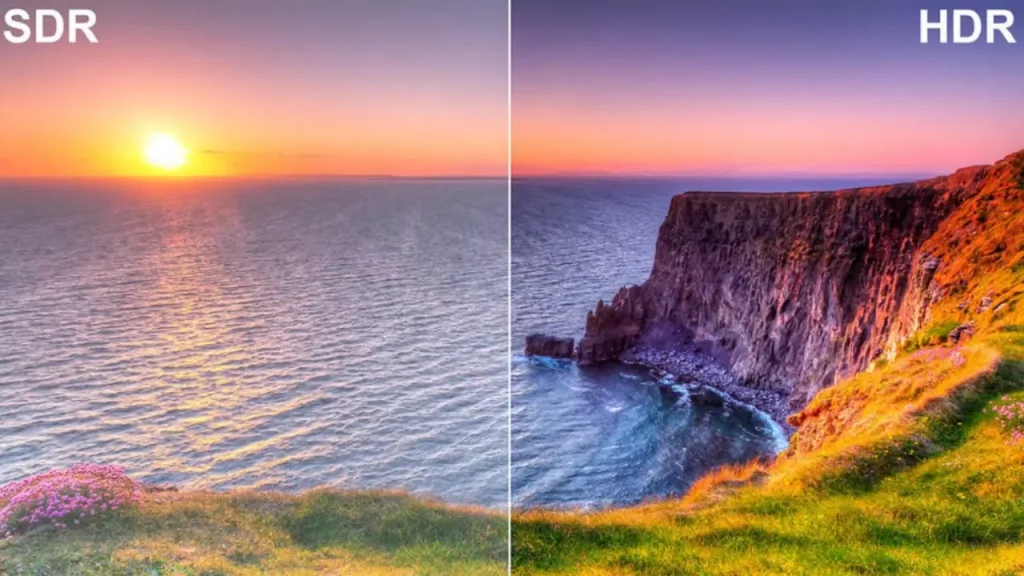
Why HDR Is Popular in Real Estate Videos
HDR has become a favorite for modern videography for several reasons:
- Better exposure in mixed lighting
Property tours often have a mix of bright outdoor light coming from windows and darker indoor areas. HDR preserves both instead of forcing the camera to choose one. - More realistic color representation
Warm woods, marble countertops, greenery, ocean views, all appear richer and more authentic. - Higher emotional impact
HDR produces an almost cinematic quality that feels premium. When a buyer feels emotionally connected to a space, they’re more likely to book a showing.
Because of these strengths, HDR has reshaped how many production teams approach real estate video editing.
Limitations of HDR
As great as HDR is, it does come with a few challenges:
- Not all screens display HDR correctly
Some older devices will convert HDR to SDR, which can look flat or washed out if not graded carefully. - More demanding editing workflow
Editors must understand HDR profiles, color grading, tone mapping, and export settings. Without proper expertise, the video may lose detail rather than enhance it. - File sizes are larger
More data means heavier footage and longer export/upload times.
So while HDR can look incredible, it must be handled with care.
When SDR Is Still the Best Choice
SDR hasn’t disappeared, and in certain situations, it remains the smarter option:
- If your viewers mainly watch videos on older devices or basic phones
- If the agent wants fast delivery and doesn’t need premium visual style
- If the property doesn’t rely heavily on dramatic lighting or outdoor scenery
- If you’re producing videos for MLS platforms that compress footage significantly
SDR is also easier and more predictable in editing, what you see is what most viewers will see.
HDR vs. SDR: Which Should You Use?
There is no single correct answer. Instead, ask these questions:
| Question | If YES | If NO |
|---|---|---|
| Is the property high-end or luxury? | HDR | SDR |
| Are there large windows / ocean / city views? | HDR | SDR |
| Will most viewers watch on modern TVs / YouTube? | HDR | SDR |
| Do you want cinematic, emotional visuals? | HDR | SDR |
| Do you need a fast turnaround with minimal editing? | SDR | HDR |
In general:
- HDR = premium, emotional, cinematic appeal
- SDR = practical, reliable, fast to deliver
A growing trend in the industry is shooting in HDR but mastering for SDR and HDR simultaneously, allowing editors to produce multiple versions depending on publishing platforms.
Why Real Estate Video Editing Matters More Than Format
Whether you choose HDR or SDR, the true difference comes from the editing process:
- Correct color grading
- Stabilization and pacing
- Lighting correction
- Lens distortion removal
- Music and transitions
- Clean property storytelling
Format alone doesn’t guarantee a great real estate video, skill does.
Why Choose Lumatrix Media
If you’re still unsure whether HDR or SDR is right for your listing, that’s exactly where we help. At Lumatrix Media, we are a team of professional editors with years of experience specializing in real estate video editing. We understand lighting, client expectations, emotional storytelling, and platform requirements whether you’re an independent agent or a full-scale brokerage.
Let us help your footage shine. Explore our samples, see the transformations for yourself, and partner with Lumatrix Media to make every property stand out with confidence.

Our blog
Lastest blog posts
Tool and strategies modern teams need to help their companies grow.
Realtors Should Have a Repeatable Listing Marketing Process
Learn why realtors need a repeatable listing marketing process to save time, maintain quality, reduce [...]
Reducing the Price Does Not Always Solve a Listing Problem
Learn why reducing the price of a home does not always lead to more offers [...]
Why Realtors Need Different Marketing Strategies for Different Price Ranges
Learn why real estate marketing strategies should change across different price ranges, from buyer expectations [...]
Why You Should Shoot More Real Estate Footage When Filming a Property
Learn why filming more real estate footage during a property shoot gives editors more options, [...]
Why Filming for Social Media Is Different From Filming a Property Tour
Learn how filming for social media differs from a traditional property tour, including framing, pacing, [...]
Why Music Choice Can Change How Buyers Perceive a Property
Discover how music choice can influence the way buyers perceive a property, from mood and [...]
Why Small Rooms Need Different Camera Techniques
Learn why small rooms require different camera techniques in real estate photography and video, from [...]
Why Some Real Estate Footage Looks Good but Edits Badly
Learn why some real estate footage looks great on its own but becomes difficult to [...]